











World’s Largest Active Armies in 2026: China Leads, India Second as Ukraine Jumps in Global Ranking
China remains home to the world’s largest active military force in 2026, with India in second place and the United States ranking third. The latest ranking also shows how war, regional tensions, and security priorities are reshaping military manpower worldwide.

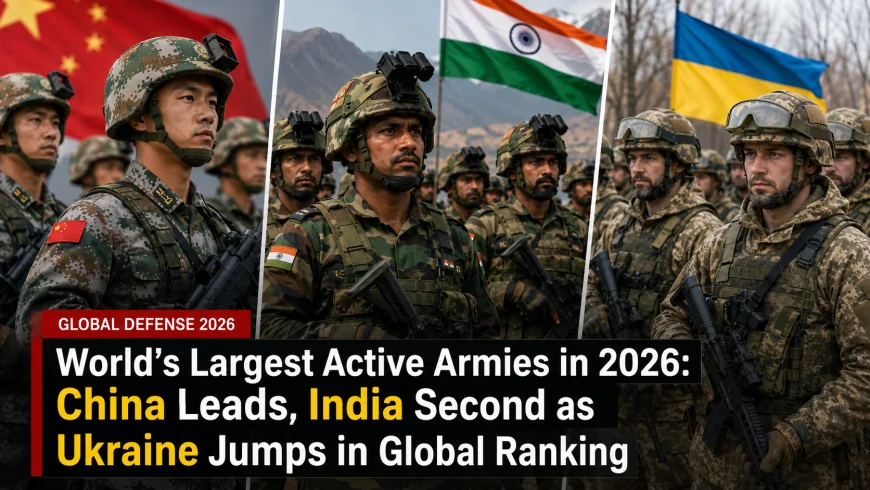
China has the world’s largest active military force in 2026, holding the top spot with about 2 million active personnel, while India ranks second with 1.4 million and the United States comes in third with roughly 1.3 million. The latest global ranking also highlights major shifts driven by war and regional security pressures, with Ukraine rising sharply and North Korea remaining one of the most militarized countries relative to its population.
The ranking focuses on active-duty military personnel, meaning full-time service members who are immediately available for deployment. It does not measure reserve forces or paramilitary units, making it a clearer snapshot of how much ready military manpower countries maintain at any given time.
Top 20 Countries by Active Military Personnel in 2026
| Rank | Country | Active Personnel | Population |
|---|---|---|---|
| 1 | China | 2.0M | 1.41B |
| 2 | India | 1.4M | 1.48B |
| 3 | United States | 1.3M | 349M |
| 4 | Russia | 1.3M | 143M |
| 5 | North Korea | 1.3M | 27M |
| 6 | Ukraine | 900K | 40M |
| 7 | Pakistan | 660K | 259M |
| 8 | Iran | 610K | 93M |
| 9 | Ethiopia | 503K | 139M |
| 10 | Türkiye | 481K | 88M |
| 11 | Vietnam | 450K | 102M |
| 12 | South Korea | 450K | 52M |
| 13 | Egypt | 439K | 120M |
| 14 | Colombia | 429K | 54M |
| 15 | Indonesia | 405K | 288M |
| 16 | Morocco | 400K | 39M |
| 17 | Mexico | 387K | 133M |
| 18 | Brazil | 376K | 214M |
| 19 | Taiwan | 361K | 23M |
| 20 | Eritrea | 350K | 3.6M |
China, India and the US Still Set the Global Pace
China’s position at the top is not surprising. With the world’s second-largest population and years of sustained military modernization, Beijing continues to maintain the largest pool of active troops. Its military scale reflects both long-term planning and a broader push to strengthen national defense across land, sea, air, cyber, and missile capabilities.
India remains in second place with 1.4 million active personnel. That number underlines the country’s size, but it also reflects the security demands of its region. India faces a complicated strategic environment, including long-running border tensions and the need to maintain readiness across multiple fronts.
The United States ranks third with roughly 1.3 million active troops. While it does not lead in manpower, Washington still stands apart in terms of military reach, technology, and defense spending. In practical terms, the US military combines a smaller active force than China with unmatched global logistics and operational capacity.
Russia, North Korea and Ukraine Draw Special Attention
Russia sits in fourth place with around 1.3 million active personnel, nearly matching the United States by headcount. That figure reflects the country’s war footing and the demands created by its prolonged conflict with Ukraine.
North Korea is among the most striking cases in the ranking. Although its population is only about 27 million, it fields roughly 1.3 million active personnel. That means a significant share of its citizens are directly tied to the armed forces, underscoring how heavily the state prioritizes military readiness.
Ukraine’s rise to sixth place is one of the clearest signs of how war can rapidly reshape force size. With about 900,000 active personnel and a population far smaller than many countries below it on the list, Ukraine now ranks among the world’s largest active militaries because of the continuing pressure of the war with Russia.
Big Population Does Not Automatically Mean a Bigger Army
One of the clearest takeaways from the 2026 ranking is that population alone does not determine military size. Indonesia and Brazil, for example, each have populations above 200 million, yet both maintain active forces of fewer than 450,000.
That contrast shows how military manpower is often shaped less by demographics and more by strategic necessity. Countries facing direct external threats, territorial disputes, or persistent regional instability are more likely to sustain larger active forces.
This helps explain why countries such as Taiwan and Eritrea stand out. Their total populations are relatively small, but both maintain unusually large active forces for their size because of security concerns and the need for constant readiness.
What the 2026 Ranking Really Shows
The latest ranking is not just about who has the most troops. It also reveals how governments respond to the risks around them. China and India remain high on the list because of scale and strategic ambition. The United States remains a military superpower even without leading in active manpower. Ukraine’s rise reflects the reality of active war, while North Korea’s position shows how political isolation and military-first priorities can shape the size of a standing force.
It is also important to read these numbers carefully. Active personnel figures show the size of a country’s full-time force, but they do not tell the full story of military strength. Training, equipment, air power, naval capability, technology, logistics, and defense budgets all matter when comparing real combat power.
Bottom Line
The world’s largest active armies in 2026 tell a larger story about geopolitics, pressure points, and national priorities. China remains first, India holds second, and the United States stays near the top, while Ukraine and North Korea stand out for very different reasons. Taken together, the numbers show that in today’s security environment, military size is shaped not only by population, but by threat perception, strategy, and the demands of an increasingly unstable world.
What's Your Reaction?
 Like
0
Like
0
 Dislike
0
Dislike
0
 Love
0
Love
0
 Funny
0
Funny
0
 Angry
0
Angry
0
 Sad
0
Sad
0
 Wow
0
Wow
0